

WEBTOON Entertainment dropped their Q1 financial report earlier this week and everyone has opinions.
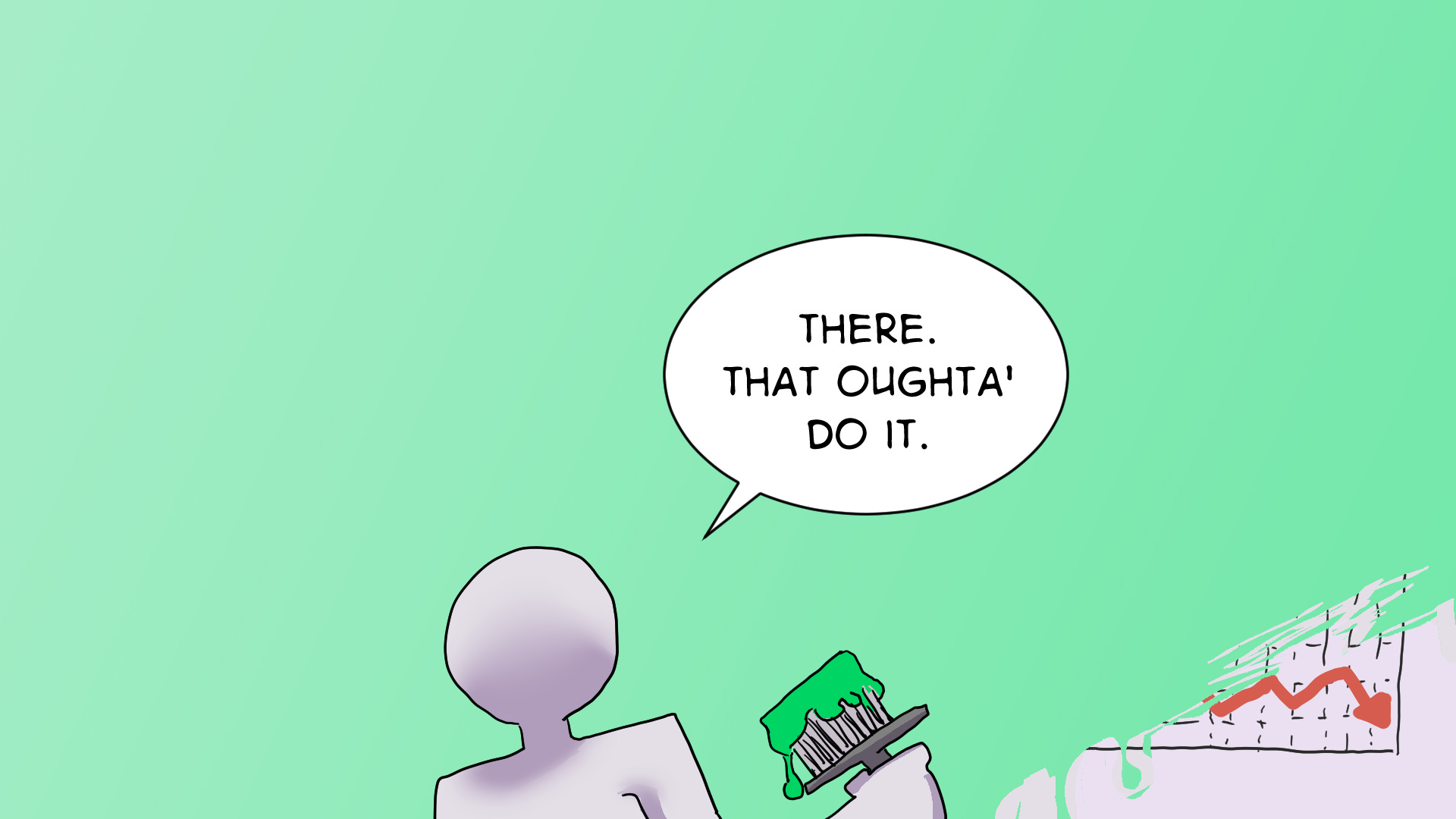
On the one hand, Wallstreet’s disappointment could be keenly felt when the stock prices dropped about 15% to $11.24 with a lot of news outlets focusing on the operating loss in Q1 or the narrowing of that loss based on their revenue.
The Q1 is full of interesting insights, but I’m going to limit myself to three points. These are continuations of the challenges that WEBTOON has faced over the past few years and, I expect, will continue to be a thorn in their side until they’re dealt with.
International Growing Pains (Without Much Growth)
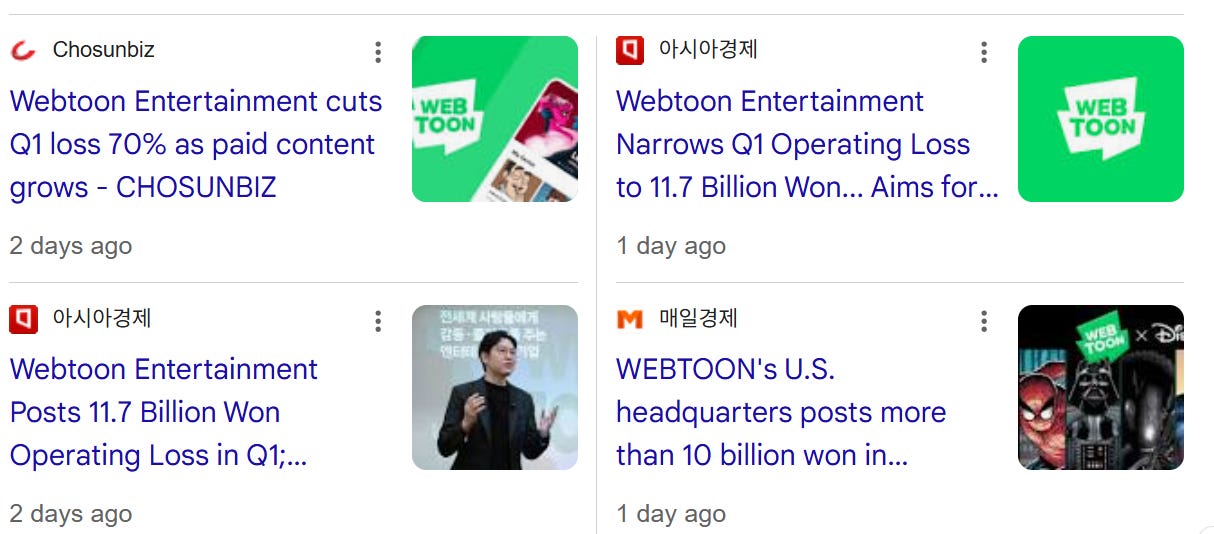
Media outlets in Korea have honed in on WEBTOON’s operating losses for Q1 because… well, because that’s the most obvious takeaway from the financial report.
My take is a bit more nuanced, but amounts to the same. Having worked at two webtoon platforms, seeing a drop in Q1 isn’t a surprise. But where the hit is coming from and where it’s being seen concerns me.
Total revenue of $320.9 million declined 1.5%, driven by declines in IP Adaptations and Advertising, partially offset by growth in Paid Content.
Year-on-year, WEBTON saw a 1.5% drop in overall revenue from 2025. And that alone isn’t a massive issue considering that Q1 is a difficult time for the webtoon industry as a whole. Coming off the heels of the holiday season, a shrink in spending is to be expected and keeping the YoY within 5% isn’t bad considering,
Korea actually saw growth with 86.88 million USD (12.8%) in revenue with the Rest of World clocking in at 35.368 million USD (7.8% YoY). But the Japanese market shrank by 7.5% YoY to 139.182 million USD.
Until Q4, Japan’s paid content revenue grew consistently throughout 2025. And while this past quarter’s 7.8% shrink in paid content revenue represents a hitch in that step, it’s a big hitch.
The Japanese market was long considered the biggest market for the webtoon industry. And if WEBTOON has peaked there, then all that’s left is to fight it out with comic books and movies in the west and mangas in the east. Basically, the age of expansion is over and it’s all red ocean from here.
Stretching the CANVAS to the Breaking Point
Under normal circumstances, I might expect WEBTOON’s latest updates to their CANVAS analytics to result in a new boom to creativity and the amateur webtoon market which would in turn give WEBTOON the momentum to turn the flywheel just a little bit further.
There was a period of time when webtoons could’ve been the medium of choice for storytelling and short-form content. And WEBTOON was at the forefront with comics like Blue Chair, Let’s Play, and Lore Olympus.
It’s been a string of mistakes, one after another since that has eroded the webtoon creator market outside of Asia. It doesn’t help that WEBTOON has no other compatriots in this space promoting the creator market. Tapas has long since abandoned the endeavor since they were bought out by Kakao leaving a one-party system.
I would argue that the golden area of webtoons only existed because there were so many amateur creators promoting the platforms, publishers, and stories outside of Asia. And as those creators are moving on to other mediums, so is that attention.
Is it a good thing that WEBTOON is promoting CANVAS and providing updates to the platform? Absolutely.
But it’s 2026 and the phrase “too little, too late” comes to mind.
In order for WEBTOON to truly win over the hearts and minds of independent creators, they need to do something besides add in features that would’ve been outdated in 2023.
Side Note: Fix Your Socials, WEBTOON
I’m sure someone at WEBTOON has noticed, but their social media needs fixing. It’s not the marketing or organic advertising promoting their platform that needs direction, but their creator outreach.
Drip feeding content to potential creators is incredibly 2020. There’s an actual opportunity to give creators feedback and promote gems across an audience of millions, but they… haven’t. And it’s disappointing.
The Flywheel Exists, Just Not Here
The flywheel in this case being the IP flywheel strategy that gets called out by most western content and IP companies. The Korean equivalent is OSMU (one-source, multi-use) which highlights using a single IP and adapting it to multiple mediums.
The flywheel, on the other hand, is contingent on additional factors like licensing, merchandising, and secondary derivatives. The best example is Disney and their catalogues TV shows, movies, and parks along with the books, merchandising and licensing based on each.
“We are pleased to share our solid first quarter results with constant currency revenue of $326.4 million, in line with our expectations, and a significant Adjusted EBITDA increase of 132% year-over year. Importantly, we are continuing to strategically invest across our flywheel. We remain focused on expanding our creator ecosystem, and will introduce major updates to our amateur CANVAS platform throughout the year, positioning us well to produce even more diverse content that our users love.”
I’ll be honest, I was pleasantly surprised to see the term “flywheel” used instead of “OSMU”. And Naver’s commitment to capitalizing on their IPs seems honest with their contributions to each year’s World Webtoon Festival not to mention the comments by Kim Young-soo about developing “Disney-level” mega IPs (Chosun Biz).
But the fact that the biggest comics publisher in the world is still looking for new IPs to develop into mega IPs makes you wonder if they know what a mega IP is.

WEBTOON isn’t alone in their goal of developing IPs and expanding them beyond the webtoon and webnovel markets. But the number of failures to do so by Korean companies could fill the length of modern Korean history.
Sorry, let me rephrase that.
The number of failures to develop IPs and expand them beyond their initial media literally fills the length of modern Korean history.
Author’s Note: I’m going to be honest here. I feel a bit uncomfortable saying the next part of this out loud because I still work in the webtoon industry and Korean content industry. For that reason alone, I’ve paywalled the next part of the article. Apologies.
