

I am not a lawyer and certainly not your lawyer. The opinions below are my own based on my experience handling contracts for publishers and platforms in the webtoon industry.
I should also state that in the Reddit post I linked below, the contract is linked to a webnovel publisher in the United States. But, it is a Reddit post, and there’s no way of knowing whether the contract is actually from that publisher.
If you’re looking for legal advice from an actual legal professional, check out this post by Kevin Dong on Odin Law and Media.
But I do have enough experience to know when a contract is shit.
Last December, a publishing contract starting making the rounds on Reddit’s Progression Fantasy subreddit followed by a walk-out of several creators from the publisher the contract allegedly belonged to.
If you want to read the contract that was posted to Reddit, you can find it here.
For anyone who isn’t familiar with publishing contracts, there are many different contracts with different terms, payment structures, and rights exchanges, but one thing is constant: publishers license rights and, in exchange, offer the author compensation.
If you’re looking for a shorter read, check out my much shorter post below.
The Dark Side of Webnovel Contracts: 4 Red Flags Creators Should Know

A quick primer on what to look out for when looking over publishing contracts in the webnovel (and webtoon) industries.
A Quick Word on Rights
If you’re familiar with publishing contracts, you can skip this section. If you’re not, DO NOT SKIP THIS SECTION.
There are multiple rights that are involved when signing a publication contract for webtoons and webnovels. When contracting with platforms like Lezhin, Tapas, Ridi, or WEBTOON, the main right involved is digital publicaiton or digital distribution. That gives the platform the right to publish and distribute a licensed title on their or other platforms.
Outside of digital publication, platforms and publishers might ask for translation rights, adaptation rights, sublicensing (allowing the publisher to re-license the title to other publishers) and so on.
Most importantly, these rights can be exclusive or non-exclusive. “Exclusive” means the right is given solely to the contracted publisher.
Generally speaking, exclusive contracts offer more in terms of advances or minimum guarantees because the company is getting exclusive rights to a title. Non-exclusive contracts sometimes include advances or minimum guarantees, but they’re generally lower because the rights involved aren’t exclusive.
A simple way of looking at publishing and distribution contracts are a trade. Studios and creatives offer rights to publishers/distributers and receive compensation in the form of revenue share, advances, and/or minimum guarantees.
Increasing the exclusivity and number of rights increases the compensation. Mostly. Unless you’re a shitty publisher.
I hope that’s understandable because now we’re jumping straight into the contract that was posted on Reddit.
An Intro to Red Flags
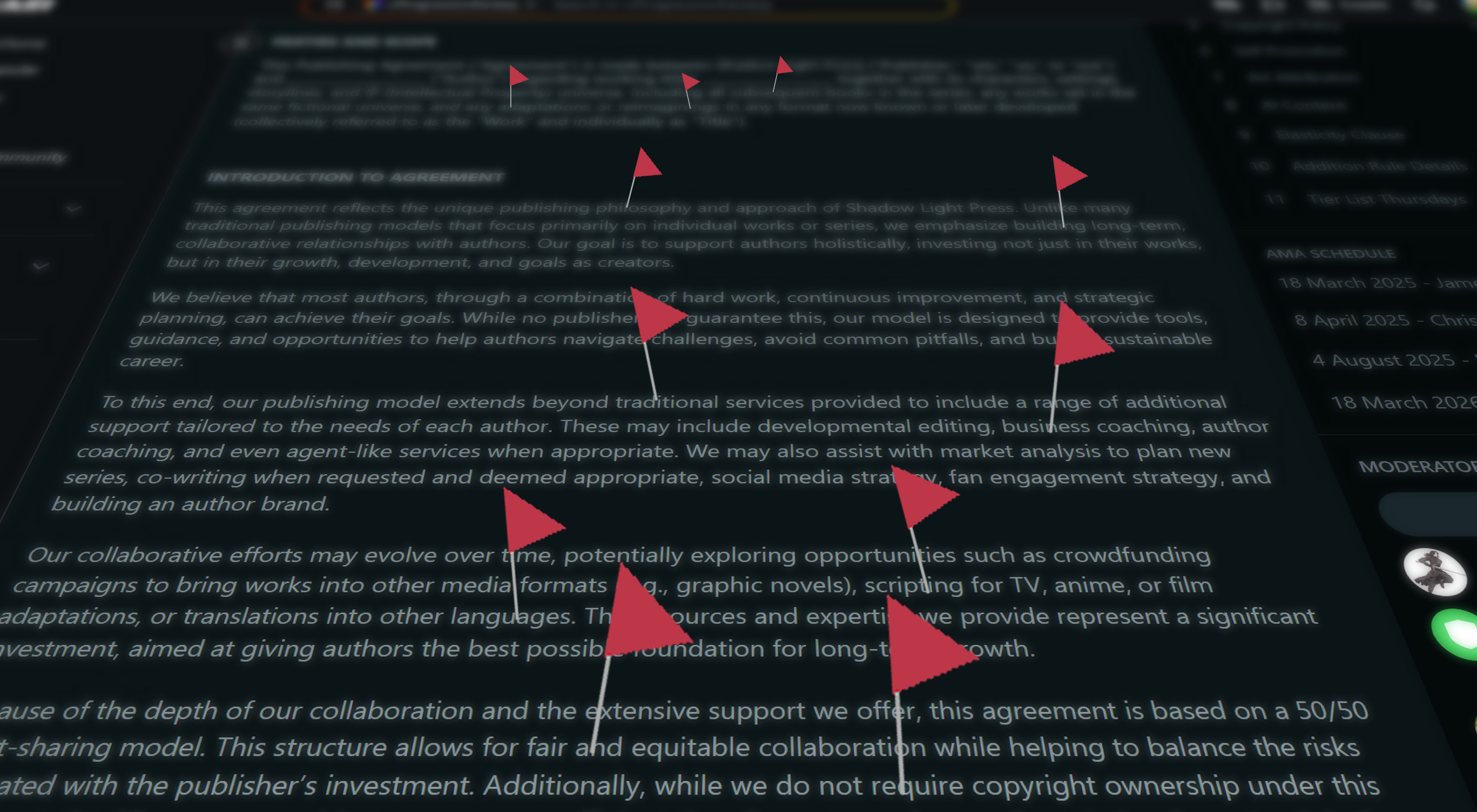
Right below the Parties and Scope, the publisher has added an Introduction to Agreement. I don’t know about the west, but I’ve never seen this in the contracts I work with in Korea. And worse still, it reads like a manifesto. And while statements like these might be common on a company’s “About Us” page, it’s full of red flags as an introduction to a legal document.
To this end, our publishing model extends beyond traditional services provided to include a range of additional support tailored to the needs of each author. These may include developmental editing, business coaching, author coaching, and even agent-like services when appropriate. We may also assist with market analysis to plan new series, co-writing when requested and deemed appropriate, social media strategy, fan engagement strategy, and building an author brand.
The only way for a publisher to offer services that extend beyond traditional limits is to contract in rights beyond the norm. Which this contract does in spades.
A massive concern should be the publisher’s inclusion of business coaching, author coaching, and agent-like services. While it’s true that modern publishers often act as editors, publishers, and agents, the blurring of lines doesn’t mean that publishers should act like editors, publishers, and agents. Specifically because agents should be acting on-behalf of authors, not publishers.
Because of the depth of our collaboration and the extensive support we offer, this agreement is based on a 50/50 profit-sharing model. This structure allows for fair and equitable collaboration while helping to balance the risks associated with the publisher’s investment. Additionally, while we do not require copyright ownership under this agreement, the 10-year renewable term ensures sufficient time for us to explore and maximize the potential of each manuscript provided.
There’s a lot here, but the 10-year renewable might be the most insane thing I’ve seen in a long time. Not just due to the length of time they’re asking for, but because of more factors that’ll become apparent later on.
The Rights Grab
The contract as a whole is a massive rights grab on the level you might expect from a large publishing house. Except a contract of this degree from a known publisher would be accompanied with an advance. Likely a large one.
The Author grants to the Publisher the exclusive, irrevocable license to publish, reproduce, distribute, sell, adapt, modify, publicly display, publicly perform, and otherwise exploit the Work (as defined above in “Parties And Scope”), in whole or in part, in all formats, languages, and editions now known or later developed, including but not limited to print, digital, audio, derivative works, media adaptations, and merchandise. This license includes the right to license, sub-license, assign, or otherwise transfer any or all rights granted herein, in the Publisher’s sole discretion, in the ordinary course of publishing and distribution.
To sum up the rights licensing above, this contract grants the publisher every exclusive right related to the webnovel in existence as well as any others that do not. Hence the “now known or later developed” bit in the contract.
Signing over rights like this isn’t unheard of. But it essentially locks a creator’s title to a single publisher without an advance and without recourse should things go sideways.
For example, if a creator signs away their rights like this and the publisher decides (for any reason) not to adapt, publish, translate, or create merchandise for the title, then no one else can. The creator is, in a word, fucked because these rights have been signed to their publisher.
If a title is of such importance that a publisher wants to lockdown any and all rights related to the title, they should be paying an advance for that priviledge.
But of course, if a publisher offers services to counter the massive rights grab, then a contract can be worth it to the creator.
Comprehensive Services: The Publisher will handle editing, cover design, formatting, and marketing at no cost to the Author**.** The publisher also provides, on an as-needed basis, developmental editing, agent services, and career coaching, supporting authors in building long-term success. These services, typically offered by third party services and agents, are included as part of our hybrid publishing approach. We believe this comprehensive support being available is essential for an author’s growth and success.
In theory, this is good for the creator. Except editing and formatting aren’t uncommon for publishers, at least not in the modern day. Cover design is also often determined by a publisher and the costs are often borne by the publisher as well. So… a lot of tooting their own horn here.
Noticeably, there are no requirements that the publisher offer developmental editing, agent services, or career coaching. The “as-needed basis” is a determination the publisher makes so it’s not even a guaranteed service for creators.
This is a common problem we’ll continue to see where the creator’s responsibilities are clearly laid out, but the publisher’s aren’t.
Marketing Costs – Direct, out-of-pocket marketing expenses incurred by the Publisher specifically for the Work, including but not limited to paid advertising, promotional mailings, and paid placements.
Specialized Expenses – Costs incurred for the Work beyond initial editing, formatting, and cover design. These may include (but is not limited to) narration and production of audiobooks, creation of second-edition covers, substantive revisions or rewrites after publication, conversion into other media formats (e.g., scripts, graphic novels, light novels), third-party agent or licensing fees, and any illustrations for graphic novelization. Publisher maintains reasonable discretion to assign expenses to this category.
Internal Costs – The Publisher’s in-house expenses related to the Work’s production, distribution, and standard launch, including editing, formatting, initial marketing, and standard cover art. A sample schedule of costs is attached as Exhibit A and aligns with industry-standard ranges.
Honestly, the defining of these costs makes very little sense on their own. They’re very common to the publishing industry and in my experience, most contracts require creators to sign over rights to allow publishers the ability to edit, market, and promote titles.
The fact that these costs are defined is a head scratcher. Until…
Cost Recoupment
i. The only costs that shall be recouped in advance, and in full before any other payments are made to the Author, are Marketing Costs and Specialized Expenses.
ii. Internal Costs shall be tracked by the Publisher and recouped from the revenue before any royalty rate increases apply.
And this is where the contract really goes off the rails.
Marketing Costs and Specialized Expenses are recouped before payments are made to the Author. So, in essence, the author pays for Marketing and Specialized Expenses.
This part had me screaming in my home office, “Then why does the author need the publisher!?”
Remember, the Specialized Expenses include production costs, and fees related to the production of audio books, second-edition covers, adaptations into other media (movies, graphic novels, light novels, etc). So not only is the author paying for marketing, they’re paying the costs of adaptation, too?!
Why does this publisher exist?!
d. Royalty Rates
i. Ebook and Print Editions – The Author shall receive 40% of Net Revenue until Internal Costs related to the Work have been fully recouped by the Publisher, at which point the rate shall increase to 50%.
ii. Audiobook Editions – The Author shall receive 20% of Net Revenue until Internal Costs have been fully recouped by the Publisher, at which point the rate shall increase to 30%.
iii. Other Forms of Media (including but not limited to film, television, stage adaptations, or merchandising) – The Author shall receive 50% of Net Revenue after all Internal Costs, Marketing Costs, and Specialized Expenses have been recouped by the Publisher.
And here we arrive at an incredibly predatory section of the rights grab.
In 2024, the Korean Creative Content Agency (which is funded by the Korean government) recommended that webtoon and webnovel publishing contracts no longer include translation and some derivative rights. This was due to complaints that translation rights were locked up removing potential revenue sources for studios and creators.
Even in contracts that do include translation and transmedia rights, many publisher contracts don’t include royalty rates. This specifically allows creatives to negotiate with publishers and platforms at a later time if their title is adapted outside the original medium.
This contract not only locks in royalty shares for the webnovel, but future adaptations as well.
Now onto Whatever the Hell This is
5. Termination, Breach, Reversion, and Future Earnings
a. Breach Notification and Cure Process
i. If either party believes the other is in material breach of this Agreement, they must provide clear written notice specifying the nature of the alleged breach, in reasonable detail. The breaching party shall have thirty (30) calendar days from receipt of such notice to cure the breach, if curable.
ii. If the breach is not cured within that period and is not contested in writing within sixty (60) calendar days of the original notice, the non-breaching party may terminate this Agreement. If contested, the matter shall be submitted to binding arbitration, and the arbitrator shall determine whether a material breach has occurred. The arbitrator’s decision shall be final and enforceable.
iii. For clarity, minor, technical, or immaterial breaches shall not entitle either party to terminate the Agreement. Publisher’s decisions regarding marketing strategy, distribution timing, pricing, promotional efforts, or platform selection shall not constitute breach and shall remain within the Publisher’s sole discretion.
Breach sections, as a rule, tend to protect whoever designed the contract. And this one reaches deep.
While it doesn’t technically assign additional rights to the publisher regarding marketing, distribution, pricing, or promotion, it removes any ability for the author to have a say in how their title is handled once it goes to market.
It should also be noted that there is nearly no provision included in the contract that could allow the publisher to be in breach of any terms listed so far. Essentially, there’s no way for the publisher to be at fault in a way that would allow the author to exit the contract. Remember, the publisher has any and all rights related to the webnovel. But how or when the webnovel is published is the “Publisher’s sole discretion”.
Essentially, the publisher has final say and disagreeing with their opinion is not grounds for breach.
What in the FXCK
And now, it gets way the fuck worse.
b. Termination Upon Breach
Upon a final determination of material breach by arbitration, mutual written agreement, or court order, the following shall apply:
i. If the Publisher Is in Breach:
1. All rights granted under this Agreement shall revert to the Author, excluding any rights that have been sublicensed to third parties.
2. The Publisher shall retain all revenue and rights derived from such sublicenses for the duration of their contractual terms.
3. The Author shall not be responsible for reimbursing any prior Publisher costs.
4. The Future Earnings Obligation described in subsection (d) shall not apply.
Jesus. That went hard.
In the case that the publisher is in breach of the contract terms (which is nearly impossible), the publisher retains revenue and rights from sublicenses and the sublicenses are valid for the duration of their contractual terms.
Essentially, the webnovel rights revert back to the author. But anything else from print to adaptations or merch would still earn revenue for the publisher for whatever term the contracts were made.
Remember, this is if the publisher is in breach which is, again, nearly impossible according to the terms of the contract. They would have to do something truly illegal in order to be in breach.
So what if the author is in breach?
ii. If the Author Is in Breach:
1. No rights shall revert unless and until the Author repays to the Publisher an amount equal to all direct, unreimbursed costs actually incurred by the Publisher in connection with the Work, multiplied by three (3). The parties acknowledge and agree that this multiplier is intended as a reasonable pre-estimate of the Publisher’s damages resulting from breach, reflecting not only direct costs but also anticipated overhead, risk exposure, and unrealized revenue opportunities, and is not intended as a penalty
2. Until such repayment is made in full, the Publisher shall retain all rights to publish, distribute, and exploit the Work without restriction.
3. The Future Earnings Obligation in subsection (d) shall apply in full.
c. Reversion Without Breach
i. All rights to the Work shall revert to the Author upon expiration of the ten (10) year term, excluding any rights and revenues from sublicenses granted prior to reversion, which shall remain in effect for their full term.
ii. If the Agreement is terminated early by mutual written agreement, reversion shall be conditioned on repayment of all direct, unreimbursed Publisher costs, multiplied by three (3), and application of the Future Earnings Obligation in Section 5(d).
When people talk about predatory contracts, these breach terms are essentially the prime example.
In the case that an author steps outside of the contract, they are now responsible for repaying the publisher 3 times the cost incurred by the Publisher.
Don’t forget, the publisher is already deducting many of those costs from the author’s royalty share to begin with.
While there are often terms in publishing contracts put there to protect publishers from authors who act in bad faith, these terms could act as a penalty to authors looking to get out of their contract.
And again, as I have said throughout this post, it somehow gets worse.
d. Future Earnings Obligation
i. If rights to the Work revert to the Author as a result of the Author’s material breach of this Agreement or by early termination, and the Work or any derivative works are subsequently monetized by the Author or any third party, the Publisher shall receive twenty percent (20%) of all Gross Author Revenue from such monetization for a period of five (5) years following reversion. For purposes of this clause, “Gross Author Revenue” means all amounts actually received by or credited to the Author (or any entity controlled by the Author) from the exploitation of the Work or derivative works, before deduction of any expenses or commissions.
ii. This obligation applies to all formats and channels, including but not limited to print editions, digital editions, audiobooks, translations, merchandise, adaptations, sequels, spin-offs, and performance or media rights, to the extent they are derived from the Work.
iii. The parties acknowledge and agree that this continuing participation is a fair and reasonable allocation of revenue in recognition of the Publisher’s original investment, editorial and marketing efforts, and the enduring commercial value created under this Agreement.
Here’s where we get to the “What in the fxck” section of the contract.
If the author breaches the contract (which is literally the only way to end the contract early), then 20% of gross author revenue from monetization of the webnovel as well as any derivative works go to this publisher for five years.
It isn’t enough to ask for 20% of revenue for a period of five years which would extend any contract further than the normal terms of the contract, but it’s 20% of the gross revenue?!
Christ on a cracker.
And as if that weren’t enough, the contract actually goes further to create terms that make little to no sense and remove any responsibility from the publisher. Like invoices? Remember invoices?
e. Reporting and Payment
i. The Author shall deliver accurate semiannual royalty statements and remit any payment due to the Publisher within thirty (30) days after the close of each reporting period.
ii. If payment and accurate reporting are not received within that time, the Publisher may issue written notice specifying the breach. The Author shall have thirty (30) days from receipt of such notice to cure the breach.
iii. If the breach is not cured, the Publisher may suspend the effect of the reversion and temporarily reinstate its distribution and commercialization rights to the Work until the account is brought current. The Publisher may also recover all unpaid amounts plus an additional sum equal to twenty-five percent (25%) of the revenue received from the Work during the period of noncompliance, which the parties agree is a reasonable pre-estimate of damages caused by delayed or withheld payment.
Remember the beginning of the post when I said the author’s responsibilities are clearly laid out but the publisher’s aren’t? Key example here.
Most publishers outline their responsibilities to the creator. In the webtoon industry, platforms lay out the responsibility to display and distribute webtoons and upkeep of the platform to provide service to their customers and the webtoon’s fans.
The Greedy Get Greedy…er
6. Author Direct Sales / Author Copies
a. The Author may request copies of the Work from the Publisher for resale or gifting. Such copies shall be supplied at the Publisher’s actual per-unit cost, inclusive of all related fees, shipping, handling, and applicable taxes. The Author shall be liable for all such costs, payable to the Publisher upon invoicing, or, at the Publisher’s sole discretion, the Publisher may deduct such amounts from revenues otherwise payable to the Author under this Agreement, including series royalties.
b. If the Author engages in substantial direct sales of Publisher-produced editions of the Work—defined for this purpose as (a) listing such editions on third-party platforms (e.g., Etsy) or (b) selling more than fifty (50) units in any ninety (90) day period, including but not limited to sales at conventions or online—the Publisher shall be entitled to its standard royalty share on the net receipts actually received by the Author from those sales, as set forth in the Royalty section of this Agreement. “Net receipts” means all amounts received by or credited to the Author from such sales, less only actual shipping charges and applicable sales taxes collected from the customer and remitted to a taxing authority.
c. All Author direct-sales programs above this threshold shall be coordinated with, and approved by, the Publisher in advance. For approved high-volume sales, or ongoing online sales, the Publisher may, at its discretion, incorporate the applicable estimated royalty into the per-unit price charged to the Author for such copies. In such case, that adjusted per-unit price shall be deemed to include and satisfy the Author’s royalty obligation for those specific units. For example, if the unit cost is $5.00, the Publisher may supply copies to the Author at $8.00, with the $3.00 difference representing the Publisher’s royalty.
I’m going to be completely honest here and say I don’t have much experience with Author Direct Sales or Author Copies. I have worked with a specific publisher in the US who offered a set number of printed copies for the creator and platform to have as in-house, sample copies. These were baked into the contract, free of charge.
And the idea that there is a large-number sales limit up to which the publisher requires a royalty share sounds reasonable.
That being said, the royalty obligation by which a publisher increases the unit cost by 60% sounds a bit steep and insane.
7. Series Commitment: The Author shall deliver a minimum of _____ manuscripts in the Series, each of which shall be subject to this Agreement and all rights and obligations herein. This minimum does not limit the scope of this Agreement; any additional manuscripts that form part of, are derived from, or otherwise fall within the definition of the Work or the Series shall also be covered by this Agreement.
8. Publisher Created Assets: The publisher retains all rights to any materials and/or assets they create, including but not limited to cover art, marketing materials, audio adaptations, illustrations, and similar content, regardless of any contract termination or breach.
9. Updates/Reissues: The Publisher retains the right to update, reissue, and adapt the Work, particularly in digital formats, to keep the content current or to adapt to new platforms. The Author will be consulted and their approval sought for significant updates, though the Publisher retains final decision-making authority.
10. Payment Schedule: The Author shall be paid their full share of profits on a quarterly basis, with adjustments made for anticipated marketing expenses, service costs for upcoming releases, and additional related expenses. These adjustments will be estimated by the Publisher to ensure sufficient funds are available to support the continued promotion and success of the Work. It is important to understand that distributors like Amazon typically impose a delay of several months on royalty payments. These initial royalties are often reinvested into marketing efforts to bolster the series’ success. This approach continues until sufficient funds are accumulated, allowing for the distribution of profits.
Finally, we've reached the end of the Breach portion of the contract.
It’s interesting that there’s even a “Series Commitment” section considering the wide breadth of the contract. It’s mostly for show because, as we’ve already seen, the publisher will be receiving any and all rights for spin-offs, prequels, sequels, and adaptations in media known or unknown.
The Publisher Created Assets are common as publishers will retain rights to materials created for the title to be published even after the contract ends. They will be unable to use them (since they have no rights to the work that the assets were created for), but creators or other publishers can purchase them from the publisher for a fee.
The Updates/Reissues section just reiterates how few rights the author has in this publishing contract. It might as well say, “Hey, you can talk but we don’t have to listen.”
The Payment Schedule is particularly aggregious because… there is no schedule. It says quarterly, but it makes no mention of an actual schedule. It says there can be delays (which is not uncommon), but there is no set date on when authors can expect payment.
And worse, it says that the royalties can be invested into marketing. Which is insane because now the publisher is outright saying that the author’s initial payments will be used on marketing.
What the fuck?
Sorry folks, but I need to take a break. I can feel my blood pressure spiking and I have the second part of this post nearly completed but it’s a LOT.
I know I’ve said this over and over again, but… it somehow gets worse.