

Before I started as a webtoon translation PM, I worked as a copywriter and a video subtitler. Copywriting at magazines, a little bit of work with Samsung for one of their early Galaxy launches, and a video subtitler (translator) at Naver back when they had a livestreaming platform.
I learned pretty quickly that copywriting in Korea starts with the Korean copy. But where you end is copy in English that has to stand on its own in the international market.
The same was true for subtitles. It needed to read like dialogue, not like translation of dialogue. No one wanted to read “Please understand our situation” when “This is the best we can do” would be better.
When I eventually found work as a webtoon translation PM, everything I’d learned from subtitling and copywriting came into play. Luckily, the webtoon translation field was still in its early stages and everyone was still shaping how webtoons should look and feel.
First (Unsteady) Steps
My first week at Big Red, I was assigned four webtoon titles. One was a new launch that was scheduled to publish in two weeks while the other three were existing titles that had been publishing in English anywhere from three months to a year. The next week, I got another three titles. The week after, another three.
Until that point, I’d never translated, much less edited, a webtoon in my life. By the end of the second month, I’d be editing one new launch every week with about four episodes edited and uploaded every day. By the end of the first quarter, that number was closer to 5 or 6 for a total of 25 to 30 episodes a week.
Deep end of the pool mentality. Absolutely mental in hindsight.

That first year included working on weekends, staying at the office until 11 PM, and working from the car during my rehearsal dinner the night before my wedding. I started at the same time as another colleague and when the team started to expand, we were adamant that the next set of webtoon translation editors start slower.
“Give them two titles the first week,” we said.
“They’re going to need time to adjust to the breakneck speed we work at,” we reasoned.
“No one’s going to stick around if you try to replicate our training schedule,” we warned.
It worked better, at least I think so.
The next set of editors worked up to 5 titles in the first month and only launched up to 2 titles a month for the first three months. It still felt fast, I’m sure, considering they were eventually in charge of 10+ titles within three months. But it gave them time to read and understand stories in order to do the best we could to translate and localize the webtoon titles.
The official job title for translation editors is “Project Manager”, or PM. You can find them at webtoon platforms, webtoon translation companies and publishers. In the first generation of webtoon publishing, PMs were responsible for the final product (the product being the final manuscripts which were uploaded to servers). That meant checking the translation, typesetting and design to make sure that (a) the episode was translated properly and (b) none of the original designs were “damaged” during the typesetting process.
In ideal cases, translators and typesetters submitted completed manuscripts that could be published as-is. And also, in those fairy tale cases, the PM was native-level fluent in the target language allowing them to perform final checks and edits as necessary.
Which, again, in ideal cases, was unnecessary.
In reality, I spent about 40 hours a week re-editing and re-typesetting webtoons during my tenure as a PM. It was everything from fixing translations, resizing bubbles, and redoing effects on typesetting. Basically, I reworked hundreds of episodes every week to read and look “better” for English native speakers. I would work on weekends to get an early start on the next week’s episodes and double-check JPEGs when they were published to make sure there were no errors on the platform-side that needed to be adjusted.
The maximum number of webtoons I edited was about 44 a week. I edited each episode with most averaging at about 25 minutes, but some taking upwards of 1 hour if the files were too large or if there was too much to edit. If episodes consistently took longer than 1 hour to edit every week, I’d start cataloging mistakes and issues in an excel sheet with screenshots to send to translators or typesetters. More often than not, it was translators. Typesetting fixes were usually 15 - 20 minutes at most.
Most PMs maxed out at 30 titles a week.
There are often other responsibilities in addition to editing webtoons including helping with copywriting, design, contracting and communicating with freelancers. Still, that was the system at Big Red that allowed for maximum publishing while still keeping a focus on quality translations.
At one point, Lezhin was, in fact, the most efficient and biggest translator of webtoon content, in the world.
Violet’s Turning Violet
(For all the young readers or non-American folks who don’t know the provenance of the quote above, I highly recommend watching “Willy Wonka and the Chocolate Factory”. Not the Tim Burton version.)
The obvious problem with the system was scale. Assuming 5 editors, a platform would max out at ~150 webtoon titles per language. In order to grow, you would need to either (a) increase the number of translation PMs or (b) cultivate a very unhealthy work environment.
It’s one thing to have a translation team of six, but considering that Korea topped out at 15,000 new webtoons in a single year… you’d need massive teams to handle the cream of the crop.
Keep in mind that Lezhin published about 50 new launches in March 2026 and WEBTOON did 40, the only option that makes sense is that they would be hiring new PMs at a rate of 1 per month (technically 2 for Lezhin’s case).
That’s 12 per year and likely topping out at 24 just to handle Korean to English. Just to handle English and Japanese, you’re looking at 48 employees to handle internal checks for one company.
Remember how I said that Lezhin was, at one point, the biggest webtoon translation company in the world?
Lezhin is a webtoon platform and publisher that, out of necessity, had to build a massive translation team that rivaled anything else in the world. At one point, LezhinUS was publishing about 25 new titles a month and everything was being edited in-house with the support of an army of freelance translators and typesetters. That’s over 200 ongoing titles in English alone which meant a team of ~10 PMs for English not to mention 6 Japanese PMs, 2 Spanish PMs and a separate division of French and German-speaking PMs (Thai and Indonesian didn’t come until later, so I’ll leave them out).
But this was a massive drag on the system. The translation PM team (who technically weren’t supposed to be translating anything) was over 20 people who each managed 20 to 30 titles in multiple languages for a company that really wanted to focus on the publishing aspect of webtoon distribution. And it wasn’t just Lezhin, similar teams and groups existed at Naver, RIDI, Toomics, Toptoon and every other webtoon platform in Korea.
Enter the translation companies.
Instead of publishers and platforms handling the translation and typesetting for webtoons in-house, translation companies presented a cheaper and easier option for webtoon translation production. By using third-party companies, platforms could reduce payroll, increase webtoon publishing numbers, and slowly shift quality responsibilities to another company altogether.
Translation companies, on the other hand, were built specifically for translation. They developed software, cloud services, and translate at scale and developed protocols built specifically for webtoons.
Everything we PMs at webtoon publishers had cobbled together through years of trial and error were fine-tuned by the translation companies with the explicit goal of increasing translation numbers.
At its core, the system isn’t much different. PMs work with freelance translators and typesetters to complete translations for clients. But by using a multitude of software and cloud services, PMs are able to handle more titles.
Often the tagline is somewhere between 100 to 400 per PM.
Someone Pop Violet
The tagline was nice.
But the fact that publishers and platforms could have lighter payrolls and shift away responsibilities for quality was more than enough incentive. Editors saw the potential of less overtime and easier schedules. Executives saw the possibility of removing the need for internal QC altogether.
For their part, a lot of translation companies scouted out webtoon translators that were employed by platforms and brought them onboard fast. I know a few of my favorite webtoon translators made the jump. And the PMs were essentially the same folks you’d meet at platforms, but they just happened to work at translation companies instead.
It started off pretty good.
There were hundreds of webtoons being translated each month. Just for reference KOCCA has a translation sponsorship program where the government pays for about 100 webtoon titles to be translated into foreign languages. That contract alone is worth about 800,000 USD.
The time required to translate, typeset and edito a webtoon completion was pretty much the same across the board. So then the competition was pricing. Who could price the translation costs lower, then the typesetting, then editing. Of course, the costs were passed onto freelancers. And when that wasn’t enough, then internal quality standards were removed or laxed in order to cut costs.
Translation firms took on editing jobs which reduced the need for PMs at platforms. This was a key turning point for the entire industry.
Because it wasn’t just that platforms were losing talent, it meant platforms were losing the talent required to know whether a webtoon translation was good or not.
If the translation firms could offer top-notch translations, then PMs didn’t have to be native-level fluent in target languages. They could just be familiar with English, Spanish, French and so on because the burden was on the translation company. And if there were mistakes, then the translation company would have to fix them.
But as those standards relaxed, so did quality standaards. And without native-level PMs on the platform or publishing side to review the quality, the overall quality in webtoon publishing saw a noticeable drop.
At least, I saw it.
The bigger webtoon publishing and platform companies still have a few PMs on staff, usually at least one for key languages. But they’re there for key accounts, important and popular titles that require more work and polish before publishing. Everything else gets a cursory glance, if that.
One of my major gripes with the scaled system was the lack of QC which resulted in flat translations. In an industry that focused on quantitative judgements like the number of typos, mistranslations and submitting assignments on time, more qualitative markers were left out to dry.
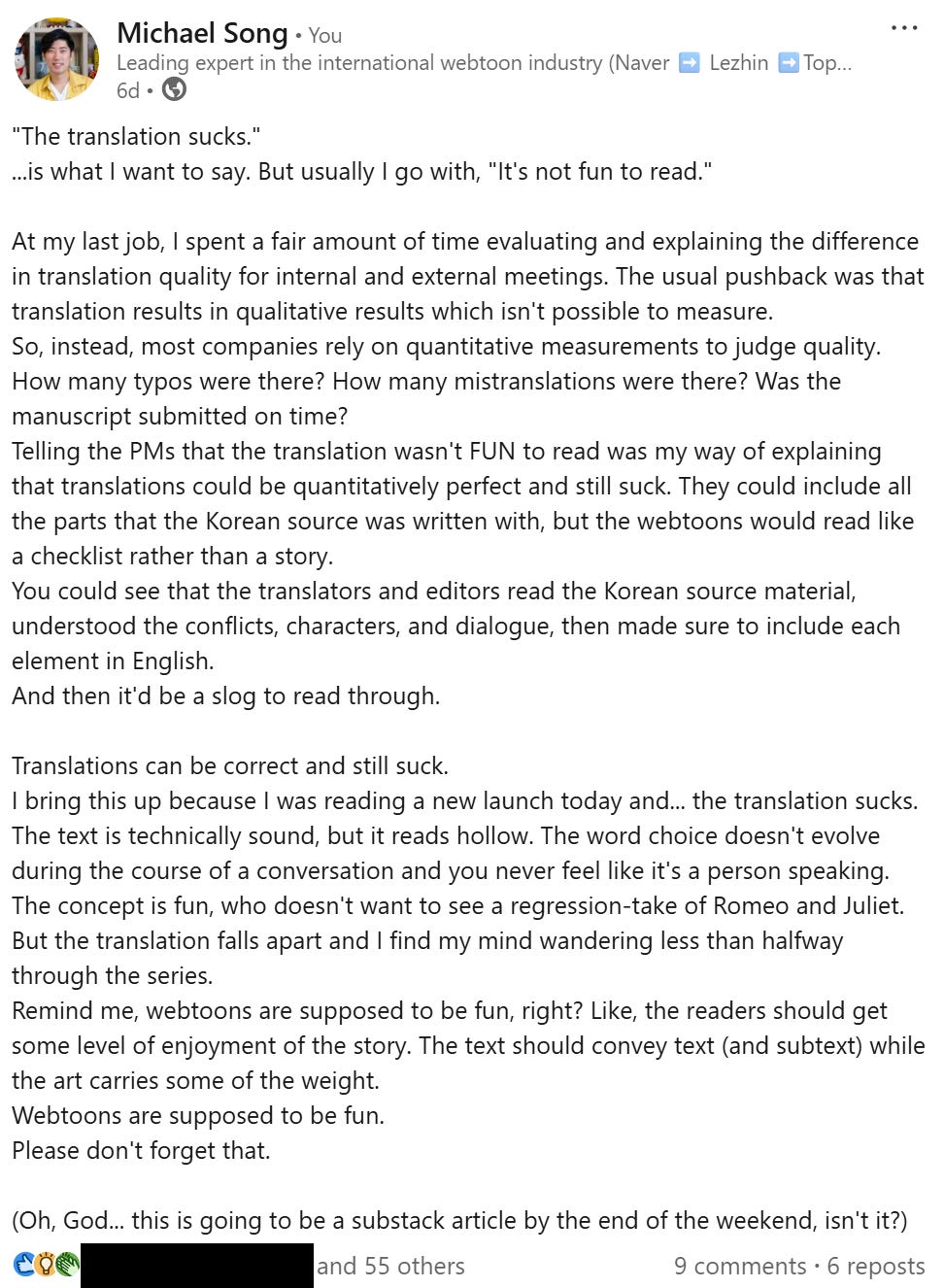
Which brings me to today.
When I was reading a new launch with a fun premise. What if Juliet (from Romeo and Juliet) regressed every time she died. And she kept on having to come back until she found her happy ending.
I’m a sucker for romance fantasy titles, even more so for titles that take existing classics and put a cute spin on them. After all, who wouldn’t want to revisit stories or characters that you enjoyed in a new light?
I should’ve been wondering what twists the story might take. Whether the story would be branching out beyond the Montagues and the Capulets. Whether Rosaline would play a larger role in this retelling. Maybe Paris could play a larger role in this retelling. The possibilities were endless.
Instead, I found myself wondering whether the translation could be fixed with a single pass in 20 minutes. Or whether I should take the hour and make a list to identify repetitive issues in the text.
Old habits die hard. I assume so does Juliet.
But if I’m honest, I won’t be sticking around to find out.
Troublingly, it’s hard to know whose responsibility the translation is. Is it the freelancer who is trying to complete as many assignments as possible to capitalize on their hourly rate? Or the PM at the translation firm who has 10 minutes a day to check quality? Maybe the PM at the platform who may or may not be fluent in English.
Undoubtedly, the platform wants more episodes to publish in order to capitalize on their ARPPU (average revenue per paid user). And the translation firm wants to reduce costs to increase their profits by reducing the number of quality checks required or hiring freelancers with lower hourly rates.
All the while, I sit reading a webtoon episode wondering if everyone in the production pipline hasn’t forgotten a key detail: I’m supposed to be having fun.