

About a year ago, Sony Animation dropped a quick teaser naming an upcoming animated film. I didn’t hear much about it aside from the name: KPop Demon Hunters.
My eyes rolled so hard I had to hold on to my desk to keep from falling out of my chair.
But then I met with someone at Crunchyroll who mentioned the movie. Their exact words were: “I highly recommend watching it” (emphasis theirs). So about a month after that conversation, it finally dropped on Netflix on June 20th and I sat my wife down a day later to actually watch it.
The phrase “blew my socks off” comes to mind.
It was immediately obvious that the film was having a moment online. TikTok, Youtube, and Instagram were immediately inundated with clips, images, and homemade dolls of the derpy tiger.
What About Korea?
KPop Demon Hunters started off on Netflix as #2 in Movies in South Korea the week it dropped on streaming. It hit #1 the next week and stayed there until July 28th when it slipped to #2. That’s five weeks as the #1 movie on Netflix in South Korea.
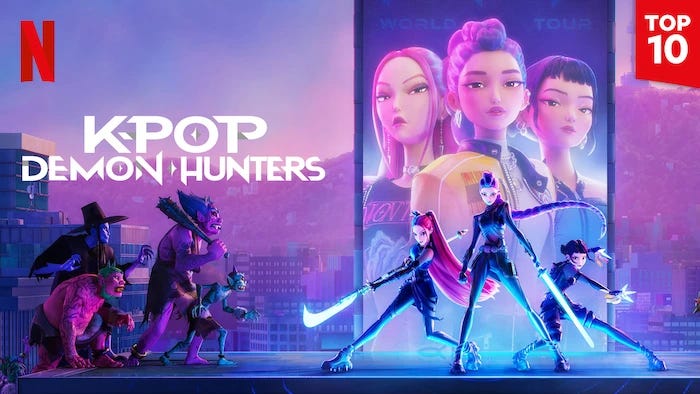
KPop Demon Hunters has spent 11 weeks on the Top 10 list in Korea, 10 of those at #1. Oh, and the movie that took #1 for a week? Holy Night: Demon Hunters.
On Genie (a Korean music streaming app), “Golden” and “Soda Pop” have been in the top 20 essentially since release. “Your Idol” is sitting at 37 after slipping from the top 10 earlier in August. “Takedown”, “How It’s Done” and “What It Sounds Like” round out the original songs in the top 100.
It’s a bonafide hit.
You’re bound to hear the song at least once or twice if you walk through shopping malls, subway stations or cafes. Of course, as newer Korean music releases, the frequency drops but it’s still there. To be honest, I could go a day without hearing “Golden”.
What is the Industry Response?
“Keh-Deh-Hun”, as it’s shortened in Korean, is becoming a case study for a lot of folks in the content industry. One interview I had specifically mentioned the quest to create an IP that could operate or perform at the same level. Heck, I’ve been to two events where the Mayor of Seoul specifically mentioned the cultural response to the film and the impact it’s had on tourism for the city.
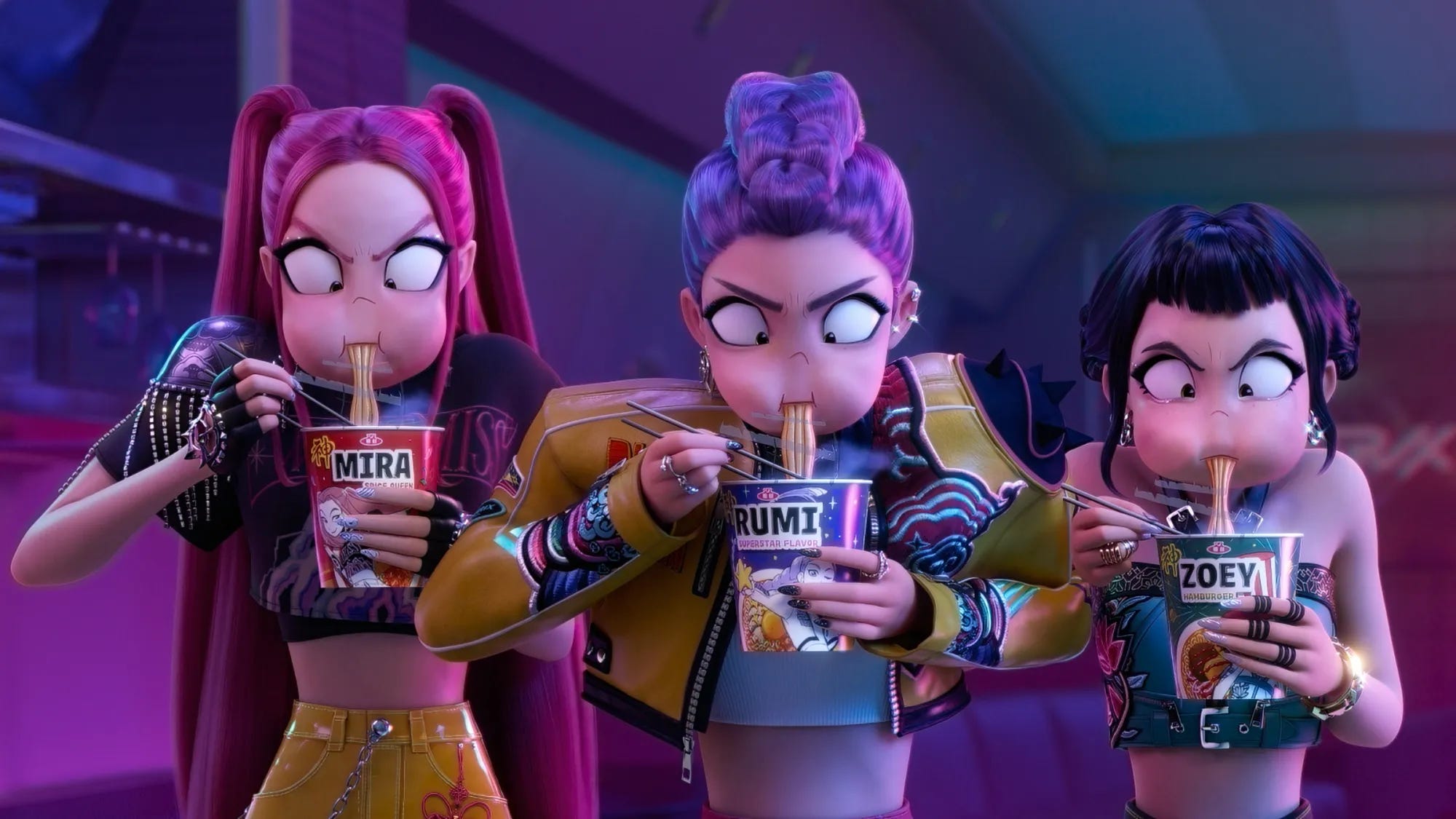
While KDH may have been produced outside the country, it’s essentially proof that an IP based heavily on Korean culture can be a massive blockbuster the world over. Whether it was meant to be or not, it’s become the golden standard of international success for an IP that wears culture on its sleeves.
Does it matter that KDH wasn’t a Korean production?
Yes, but not in the way you might think.
KPop Demon Hunters represents a lot of different things to different people. In the case of Korea, I tend to believe it’s an echo.
Korea has been sending out Korean content into international markets for decades. K-pop, books, movies, and K-dramas in bulk. And now the market has sent something back.
Something that is so intensely popular that the potential for success using a Korean IP is undeniable. Something that confirms that Korean content has entered the mainstream. KDH’s popularity isn’t just proof-positive that Korean content can be popular internationally, it’s proof that the content doesn’t have to be produced in Korea.
That leads to a major takeaway from KPop Demon Hunters that is both amazing and frightening: Korean content is bigger than Korea.
This will certainly have reprecussions for multiple industries the world over.
Just a quick reminder, South Korea is a small country. In 2024, the population was an estimated 51.75 million and thanks to a mediocre birthrate, that population is likely to start shrinking in the next decade. While the popularity of Korean content is at an all-time high, the country producing it is in dire straits.
So, what is a Korean content company to do?
There are signs of a significant shift in entertainment industries in Korea. Naver is already attempting to make themselves less reliant on the Korean market for webtoons with their recent Disney deal not to mention their Japanese endeavors with LINE Manga.
And while K-dramas have found new audiences through Netflix and international streaming, they’re also looking to spread into foreign markets much like RIDI’s Japanese short-form content platform or the overseas remakes like the Japanese “Marry My Husband” remake.

Han Kang’s Nobel Prize in 2024 was a major turning point in Korean publishing as well. While Korean literature has been slowly gaining traction in international markets over the past decade, it was almost jarring how quickly the numbers jumped after the announcement. According the Literature Translation Institute of Korea (LTI Korea), 2024 saw a 130% increase YoY in overseas sales.
So, what do you expect will change?
If I’m being honest, not much. At least not in the mid-term.
If KDH dropped six years ago, I’d say that Korean publishers and studios would be spurred on to work with overseas studios and publishers to create content that is crafted with foreign audiences in mind where they can.
But it’s 2025. That’s already happening.
Webtoon companies have been collaborating with overseas studios, writers, and artists for years. Just this month, a Korean-webtoon adaptation of French author Bernard Webber’s “Ants” was announced. The recent Amazon production “Butterfly” put an American action-drama series in Seoul and brought in major Korean actors like Kim Tae-hee (Iris), Lee Il-hwa (Good Manager), and Park Hae-soo (Squid Games).
But for everything that’s wonderful about “KPop Demon Hunters”, it’s a fundamentally not-Korean story. There are multiple elements that you don’t see in modern Korean storytelling. Yes, there is a lot of Korean culture tied into the story, but it’s about as Korean as baseball. Or maybe poutine.
The major takeaway for Korean content producers looking at KPop Demon Hunters? There isn’t isn’t one. But that’s only because I don’t think Korean studios were or are capable of producing KDH.
And… that’s not a bad thing.
I love that you used the word “echo.” It totally recontextualizes how I perceive the movie. I noticed a lot of Western ideologies mixed in with Korean concepts, and thought it might be a little haphazard, but now it feels more a bit more like a genuine attempt at cultural exchange.
The last time I felt this kind of goodwill from the mainstream towards an animated property was the A:TLA series! I spotted a toddler playing clips on an iPad on the bus home over the weekend and bopping his head to Takedown…
There should be a webtoon version - imagine all the new readers.