

It’s not any stretch of the imagination to say that the international webtoon industry is still reeling from the officially announced closure of Tapas by Kakao Entertainment.
And while we’re still a ways from seeing just how much the industry will be affected in the months and years to come, there’s something that’s been irking at me ever since the announcement was made.
Spefically, there are two major fundamental misunderstandings that are readily apparent when reading the discourse surrounding Kakao’s decision to close Tapas. So let’s unpack.
Let’s Start with the Beginning
The first misunderstanding is what the closure of Tapas means.
This is partly because while other webtoon platforms have closed, it’s never been one of this magnitude. The closest is Pocket Comics which was operated by NHN in multiple languages and locales, but even then it was a third-tier platform at best.
But the closure of Tapas is literally the number two webtoon platform shutting down operations outside of Asia. It’s a cataclysmic event that has been handled with all the grace of a middle-aged man falling down the stairs (I speak from experience).
Is the Webtoon Market Shrinking?

Earlier this year, the Korean Creative Content Agency announced that the South Korean webtoon industry had reached an impressive milestone, hitting 2 trillion KRW (~1.36 billion USD) in revenue.
While rumors of Kakao’s difficulties have been widespread, it wasn’t until September 22nd when Maeil Business and Money Today broke the story in Korea. While both are trustworthy sources, there was no official word about Tapas’ closure from Tapas, Kakao or any other source in Korea.
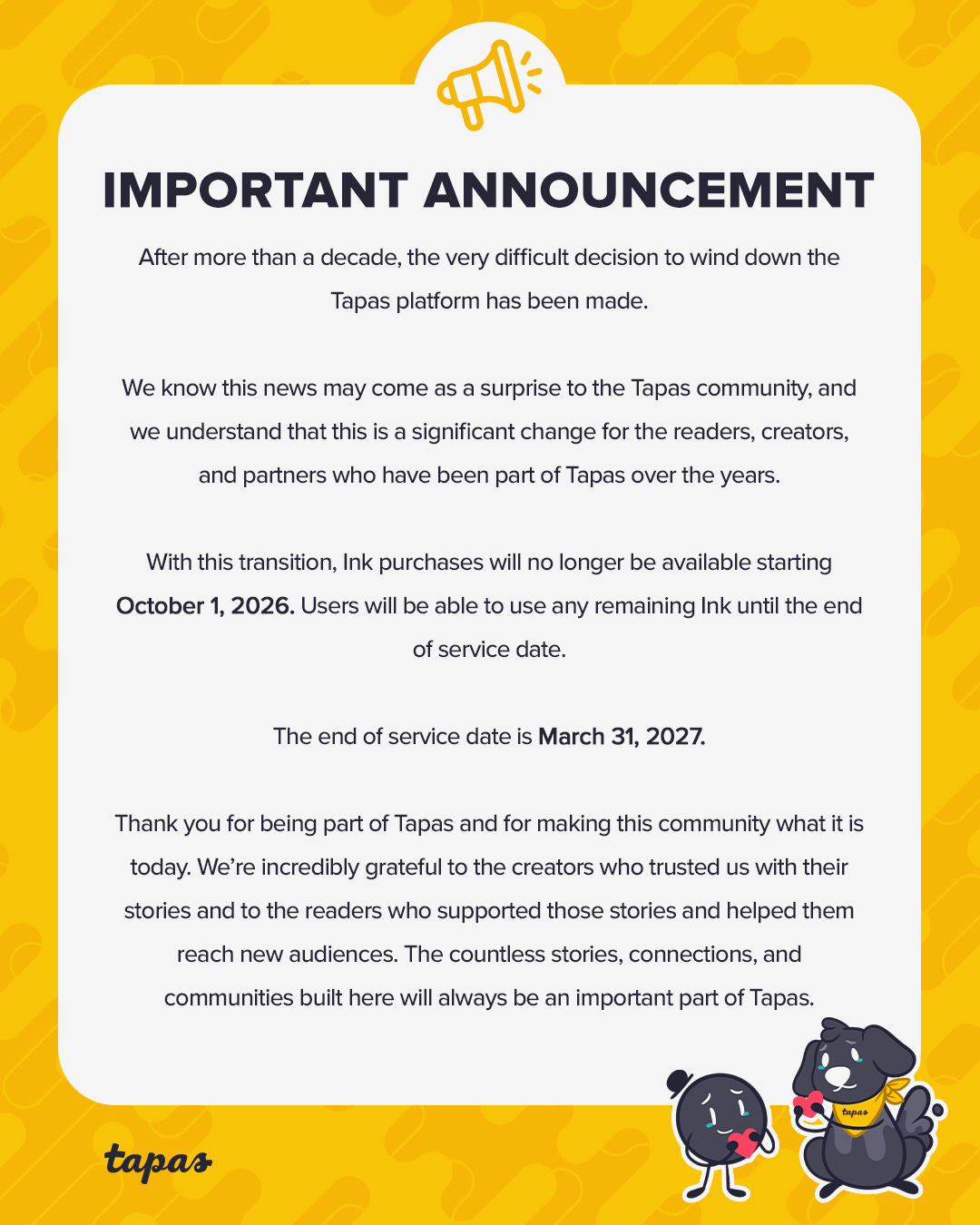
At least, until October 1st when Tapas released a statement confirming that the platform would be shutting down.
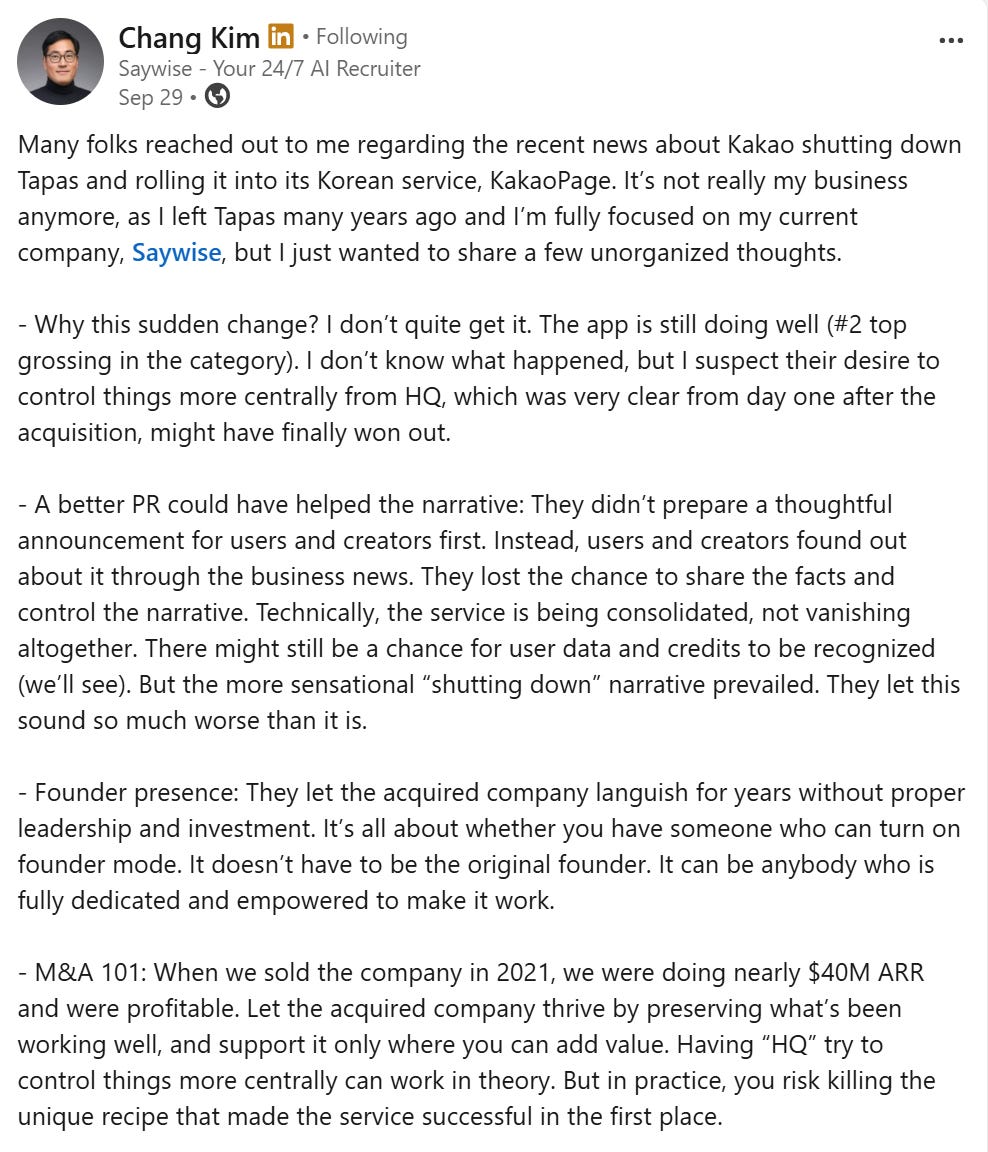
That was a 10-day window during which everyone (myself included) weighed in on the rumors without any official statement. Heck, even Chang Kim, the founder and former CEO of Tapas, weighed in on LinkedIn before we got official word.
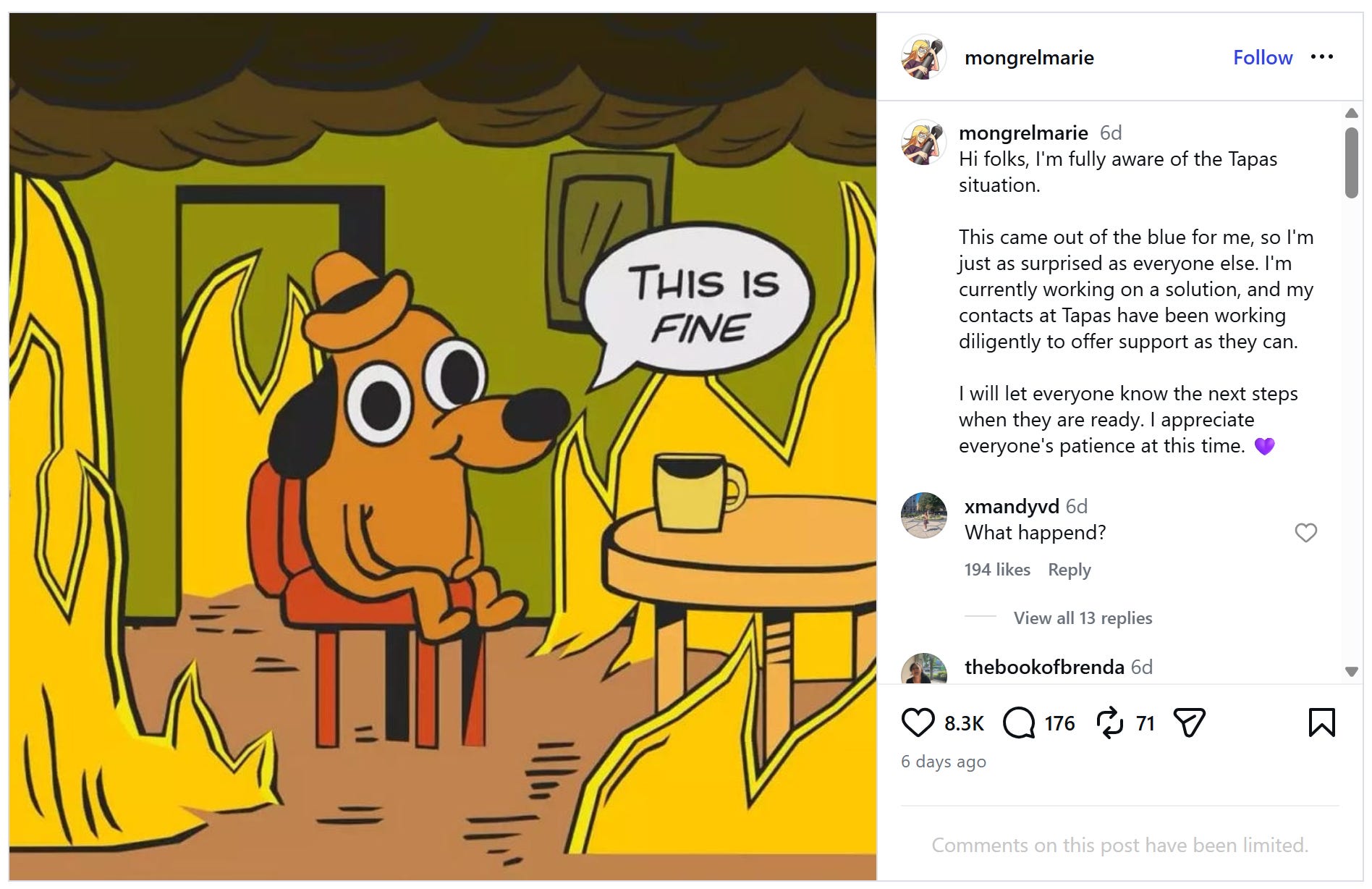
And then from all corners of the internet, we had confirmation of the biggest problem of all: almost none of the writers, artists, or creatives publishing on the platform knew.
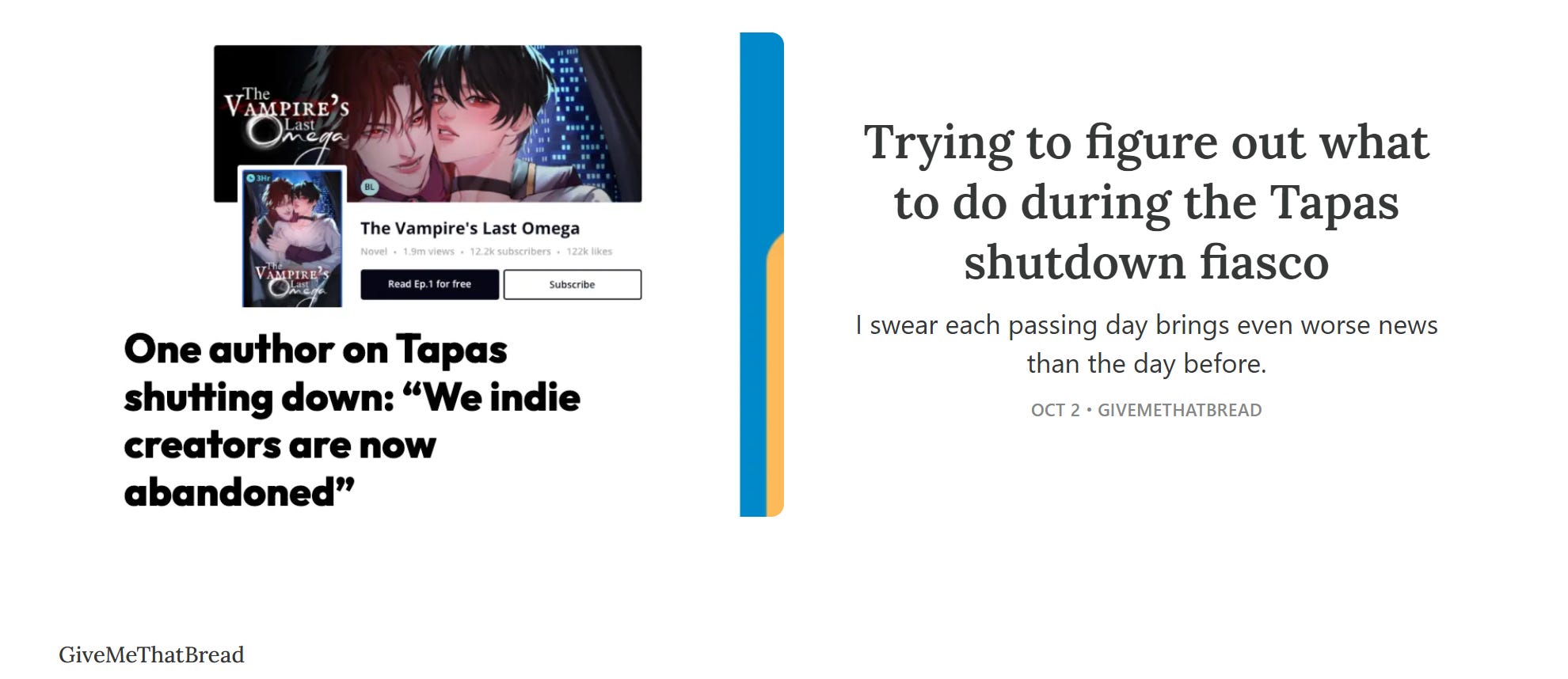
In Korea, the closure of Tapas is a strategic move. A paragraph in a larger story about a company refocusing on content in the Asian market and developing a new gameplan with the hope of expanding back into foreign markets at a later time.
The idea that Kakao Entertainment might, at some point in the next 10 years, be able to launch and activate a digital platform in the western market after pulling off one of the worst product closures in modern history is insane.
It’s a fundamental misunderstanding of what Tapas’ closure means.
Choppy Waters Ahead
The audience side has been rife with incorrect assumptions and misunderstandings of what is actually going on.
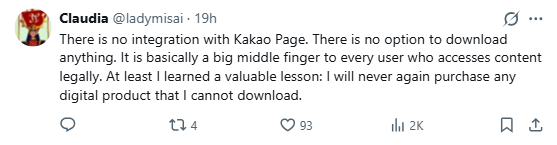
Check out Reddit and you’ll find some folks saying that Kakao is going to launch a second platform or that the purchase history will rollover to KakaoPage (the Korean platform) or that there must be a way to download the large catalogues of comics that they’ve purchased on the platform.
Of course, they’re all wrong.
Kakao isn’t launching a second platform, at least not yet. And more than likely, not before the closure of Tapas is completed. They’re definitely not rolling over accounts onto KakaoPage and they’re not offering downloads.
But the downloads… well, it’s not up to them.
Contracts for webtoons and webnovels rarely include the ability to offer them for download. It’s one of the ways that studios and creators are able to continuously earn revenue from non-exclusive licenses or by changing platforms once the licenses run out.
Yes, platforms don’t offer the ability to download content for mostly selfish reasons. But the bottom line benefits creators and studios in the long run.
Not that it matters.




Yep. The biggest effect we’re likely to see is a practical one.
Assuming Tapas held about 30% of the English webtoon market share, one would hope that with their imminent closure, that 30% would be split amongst the remaining webtoon platforms like WEBTOON, Ridi, Lezhin, Tappytoon, and so on with some percentage moving to GlobalComix and BookWalker, etc.
Except… that’s not going to happen.
The webtoon industry has been at the mercy of piracy since its inception, but it really took off during COVID when the popularity of webtoons boomed.
Naver, Kakao, Ridi, and Lezhin have all funded anti-piracy efforts internationally in an attempt to secure their content and the content licensed to them by thousands of creators.
The argument for and against piracy isn’t a moral one, it’s a monetary one. Whether or not users can or will pay for content is at the heart of the issue. And when a massive platform like Tapas shuts down, it’s hard to argue in favor of a system where millions of dollars have been spent and users will be left with nothing.
So what does Tapas’ closure mean? Or represent?
It represents a stain on the reputation of Kakao Entertainment. One that’s likely to haunt the company in future attempts to enter the western market.
It represents a failure to capitalize on one of the most popular digital mediums in the world.
And, to anyone who’s still in the webtoon business, it represents the end of the market as we know. Because it’s one thing to piss off thousands of creators, authors, and artists… it’s another thing altogether to piss off millions of fans.
It felt like Kakao just announced they were done playing with toys, mismanaged toys that ended up being the livelihood and landscape of the present day webtoon/comic industry. An intense amount of goodwill felt scorned by these actions, and I’m not sure if they even want to go back to the western market after this.
My biggest concern is for western artists and writers who were all-in with Tapas as a creator-oriented space to self-publish, and how the rights to their content will roll out. Even with an official statement, it feels like a lot is still up in the air. Having less competition in a market is always worse for the consumer