

Translators are screwed.
That’s not a predictive statement, more a summation of past and current events.
Last year, thanks to a colleage in France, I had the opportunity to talk with a publisher from a webtoon/comic/manga publisher in Europe. More than anything else, it’s always nice to meet with folks who are my counterparts in other partsof the globe.
We decided to meet at a convention held here in Seoul. I brought French-fluent colleague while the publisher was provided a translator at the convention who could speak Korean, English, French and God knows what else.
The meeting went well. I sat on the sidelines a bit as my colleague and the publisher spoke naturally in French (I got summations from the translator).
Somewhere near the end of the meeting, the translator sort of… joined the conversation. Mostly on the subject of how much translation rates had dropped in the past few years in Korea. And they blamed the webtoon industry.
Unfortunately, they were right.
There’s Words, and then there are Words
Pre-2010’s, the translation industry in Korea could be comfortably split into three arenas: entertainment, business, and literature.
Entertainment would be the subtitles for K-dramas and animations but also the scripts for those projects in the cases where they were being dubbed. You also had the rise of Youtube and online content feeding into this section of the pie which grew it significantly in the late-2010’s.
Business was a much simpler deal. These would be the meetings that required on-site translators, documents that would travel between locales, and the occasional internal media like production shorts or videos.
Finally, you had literature. Korean literature recently had a massive uptick due to Han Kang’s Nobel Prize in 2024. But the Korean Creative Content Agency has been pushing Korean literature in international markets for decades. The only slight break was during the Park administration when certain authors and artists were blacklisted from promotion (the less said about that, the better).
And this was the norm until approximately 2017.
The Meteoric Rise of Webtoons
It’s accurate to say the massive expansion of Korean webtoons into international markets upended the translation industry.
By 2023, there were hundreds of webtoons being translated into French, Spanish, Japanese, and English. Even on the short-end, that’s an additional 5 million USD worth of projects that required translators and editors to produce every year.
Take into account that projects were considerably shorter than novels and the weekly publishing schedule meant consistent work for months (if not years), it’s no wonder that the Korean translation industry quickly made space for the webtoon industry.
I still remember sitting in meetings with translation companies back in 2019 and negotiating project volume because so few companies could work at the scale we needed. I also remember realizing that the webtoon company I worked at was quite possibly the biggest translation “company” in Korea at the time.

The Fall Back to Reality
The sudden surge in webtoon translation immediately resulted in multiple translation firms shifting their focus to webtoons. Not just in a bid to make money, but to attract investments from the content companies that run webtoon platforms and publishers.
Kiwi Vine was acquired by Kakao back in 2021 and, in 2022, Kakao acquired a majority stake in Voithru (my old employers). RIDI has made their own moves with Prodifi, a tool that uses AI to translate and typeset some of their webtoons. The list goes on.
The point being that translation was no longer a highly sought after commodity. The Korean translation market reacted quickly, filling the gap nearly a year after it appeared and webtoon platforms took full advantage.
Of course, that created its own problems.
The drop in rates has been industry wide for Korean translation. Not just because of AI, but because there are thousands of translators all vying for the same work and the industry has firmly shifted their focus from quality to quantity.
There were two major factors that fed into the downfall of the webtoon translation industry: (1) the failure of overseas webtoon expansion (along with the related costs) and (2) the drive to profitability. Not only were platforms reeling from their failures in Southeast Asia and Europe, but they were looking to trim fat where they could.
It was one thing when there weren’t enough translators to go around (and companies were poaching them from one another), it’s another when AI translations launched into the mainstream.
More than a few smaller translation agencies were known to be experimenting with AI-powered translations. Mantra in Japan has been known for their work on a context-sensitive manga translator while the recent sale of Seven Seas to Manga Do has fans up in arms about the potential use of AI translation in future printed works.
All over Reddit, you can find folks who suspect AI translations in their most loved (or hated) titles. But AI translation is a double-edged sword, one that risks alienating an audience so no company has copped to it.
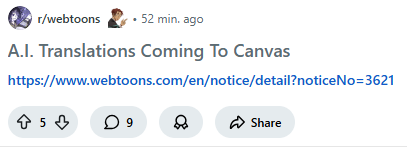
At least until Naver announced improvements to their CANVAS program.
The International CANVAS Platform
Powered by AI technology, the Translation Program is designed to help CANVAS Creators scale their stories across languages and reach new audiences worldwide, while maintaining full control over their creative and how their work is distributed. By removing language barriers, CANVAS will make it easier for Creators to build global fandoms while preserving what matters most: creative freedom, full ownership and control of their work, and a direct connection to fans.
My first thought when I saw this was, “Oof. Straight to the point, I see.”
It’s hard to say the signs weren’t there.
The closure of the Fan Translation Service in 2025 was a huge sign of what was coming. For those who aren’t in the know, the Fan Translation Service opened certain webtoon titles up for fans to translate into languages outside of the original source material. As the service was free, it could’ve been construed as a cost-cutting measure at the time.
Hindsight is 20-20.
Of course, expanding audiences for independent creators can hardly be said to be a bad thing. And the excuse could be made that without AI, the likelihood of “local” webtoons having access to a wider readerbase is impossible.
But it could also be said that WEBTOON is using AI to extract more ad revenue for CANVAS readers. Or that due to the inability for AI translations to be copyrighted, it muddies the waters in terms of pirate sites hosting AI translated webtoons.
Or, most importantly for WEBTOON, starting a paragraph in their press release with “Powered by AI technology…” is going to piss some folks off.
Hindsight is, in hindsight, 20-20.