

So, I assume there’s going to be a fair amount of internet hate on this post. I want to specify that I’m analyzing this topic through the lens of digital webtoon content in 2026. There are multiple arguments that can get mixed up here, but I’m carving out a small section to make the topic easier to discuss without getting lost in the weeds.
I also assume that no one will read this disclaimer and I’ll still get flamed somewhere on Reddit.
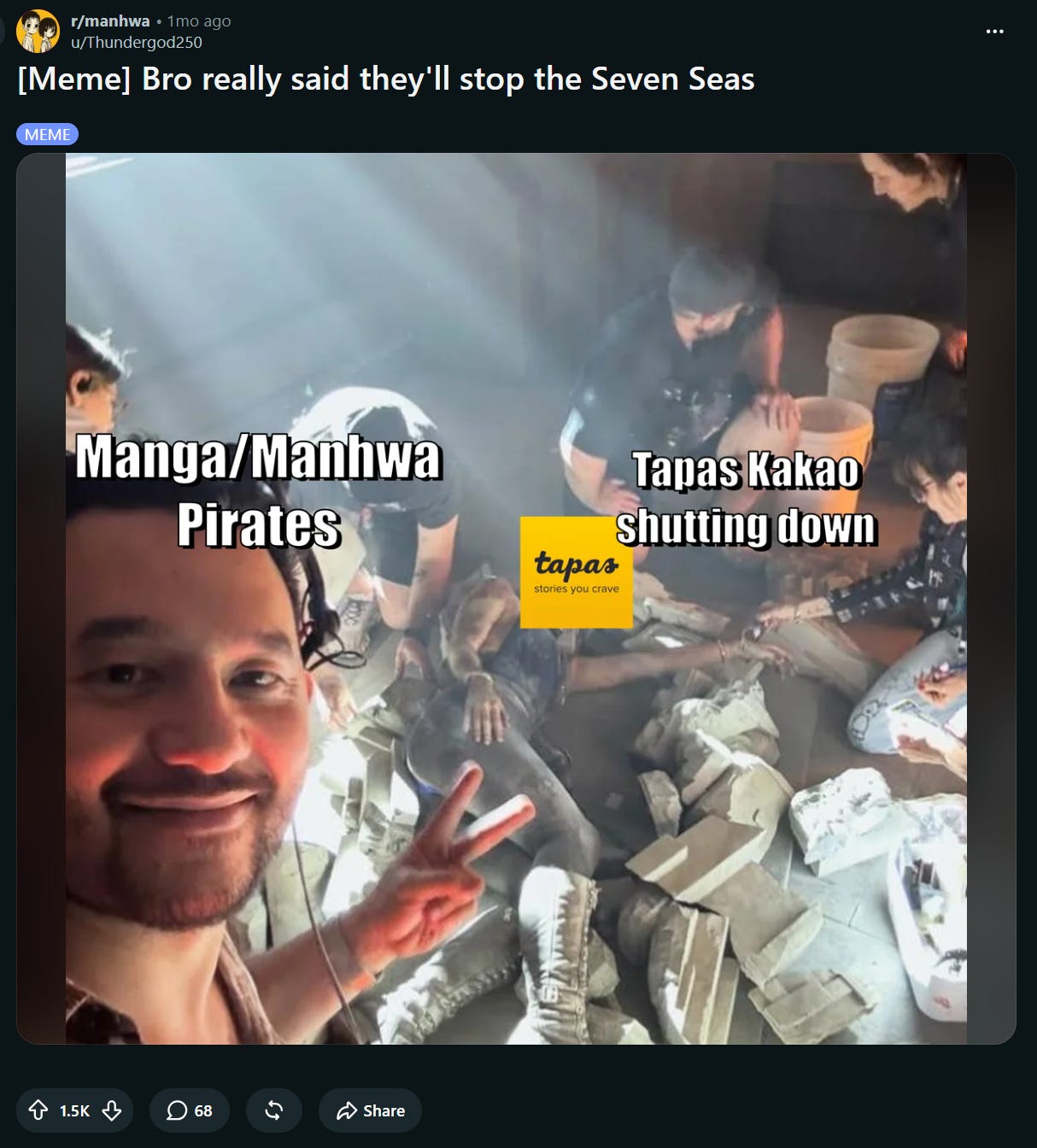
In the fallout of Tapas’ shutdown, we’re seeing renewed debates about why piracy should be (or is) an accepted practice in the manga and webtoon markets outside of Asia.

There are two major arguments in favor of piracy that don’t fail a cursory look, but I want to focus on the one that’s going to be get the most hate-clicks.
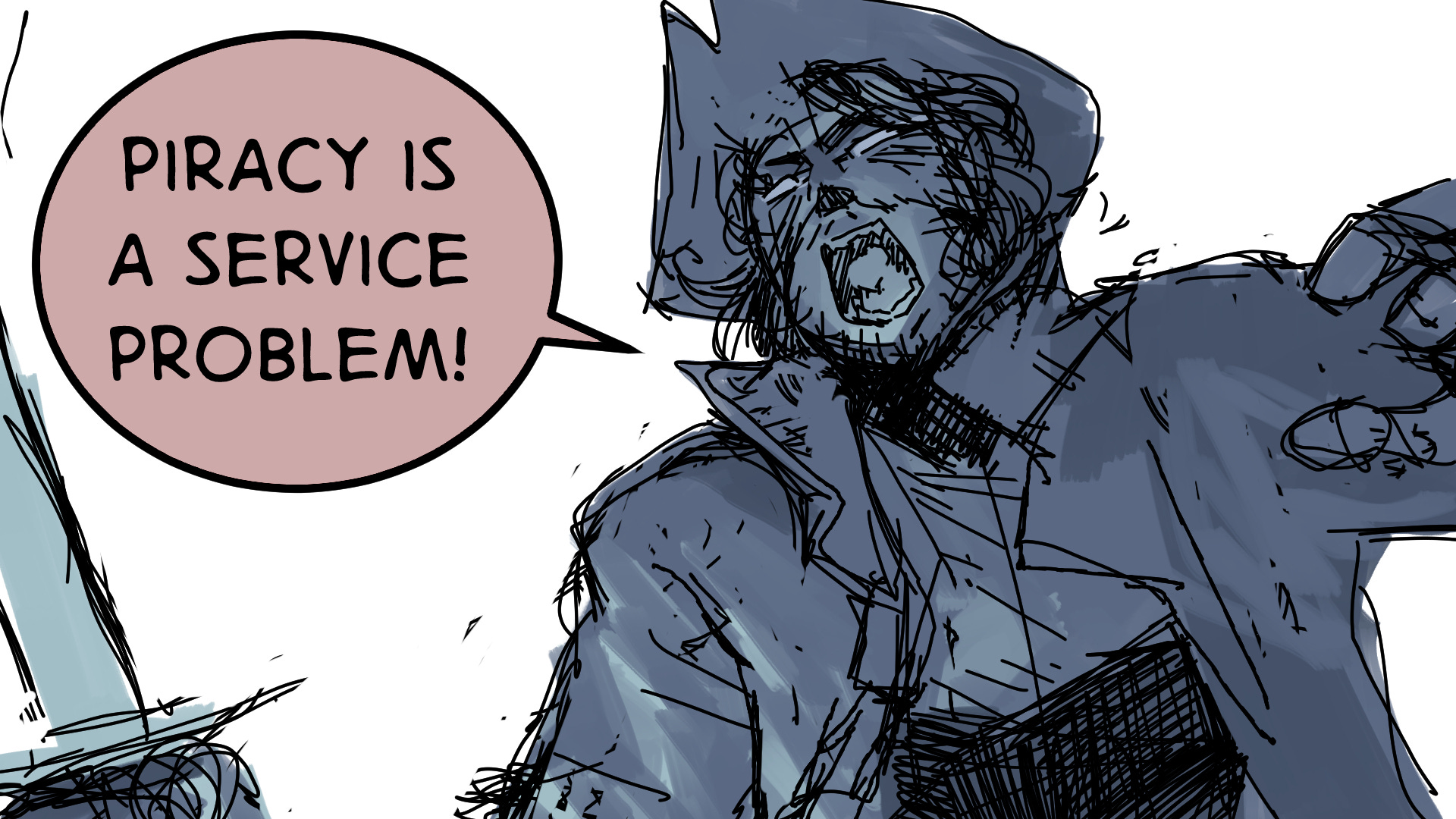
Piracy (as) a service issue
If you’ve been living under a rock or maybe you just don’t hate yourself enough to spend as much time on Reddit as I do, then you may not know of the Gabe Newell quote.

It’s often employed in service of pro-piracy arguments. “Piracy is a service issue”.
The interpretation is an easy one, piracy only exists because existing services aren’t good enough. By extension, the majority of users and audiences engaging in piracy aren’t promoting piracy, they’re defying a broken systems and practices that make up shitty services.
And, in an ideal world, that means the opposite is true.
Assuming hurdles to accessing services are lowered, then the convenience and safety of using proven and trusted service will outrank pirate sites which tend to be unsafe and untrustworthy.
Services like Steam and Netflix are heralded as proof of businesses which offer stable user experiences and large libraries of content.
Interestingly, both services came about at the peak of piracy. Netflix launched their streaming service when torrenting had peaked and the same goes with Steam. Instead of downloading games that could potentially hide viruses, malware, or purposefully coded bugs (or just horrible launcher experiences on third-party programs), Steam offered a safe and stable platform. Buy your games, install, play, and uninstall if you were done with the knowledge you could install it again at a later time.
Content streaming was likewise a difficult era for audiences. The only options at the time were (a) buy a lot of DVDs, (b) stream from sketchy low-quality sites or (c) download a file and hope it worked.
On the one hand, Netflix was (and is) cheaper than my DVD budget back in college. On the other hand, I own none of the content on Netflix and I miss special features. But the level of convenience is beyond anything that existed at the time, including piracy.
Steam, on the other hand, is still expensive. But considering the fact that physical media degrades over time (my floppy disks of Syndicate are no longer operable), it’s a meaningfully safe and stable alternative.
So then, how could Gabe Newell possibly be wrong?
The (Exact) Words of Gaben
Let’s take an acual look at the full quote from Gabe Newell back in 2011.
So we don’t really worry about piracy.
When you look at the top ten issues on our list at any given point in time, piracy is almost never on that list. And the reason that we think we don’t have issues with piracy is that theres misconceptions in the industry about what piracy is.
Piracy is about people wanting to steal stuff from you. They don’t want to pay any money and they want to get your content. But when you think about the fact that these people have two thousand dollar PCs and they’re spending 50 dollars a month or more on their internet connections, clearly they’re willing to spend money.
So from our point of view, what we saw more and more was that piracy was a result of bad service on the part of game companies.
It’s interesting because Newell specifically describes the target audience for Steam.
Spends 50 USD or more a month on internet
Has a PC costing 2000 USD or more
We need some context from 2011.
By modern standards, 2000 USD for a PC and 50 USD for an internet connection is downright cute. But in 2011, a decent gaming computer could be assembled for about 1000 USD. A powerful build for about 1500 USD. If you wanted after market cooling system to keep your overclocked Intel Core i5-2500K from burning a hole in your motherboard, you’re looking at 2000 USD.
So what kind of computer cost more than 2000 USD? A fully-loaded Macbook Pro which started at 2500 USD for the base 17-inch model and topped out at 3999 USD for every upgrade on the list. Or maybe a fully loaded desktop, but likely one by a name brand company like Alienware or even Hewlett Packard.
Casuals be damned.
Where Words Fail
The problem is, of course, that webtoons and manga are a completely different medium from video games or even videos.
There’s no existing requirement for expensive graphics cards or even a fast internet connection. A cheap second-hand phone and basic wifi connect from a cafe will do.
Unlike video games or video files which require downloads or streaming (both of which require medium to large data transfers) while viewing images online… doesn’t. And since webtoon, comic, and manga piracy hinge on viewing manga more than downloading them, the danger of malicious code is significantly less.
As a result, the difference between official sites and pirate sites comes down to two factors: cost and catalogue.
Pirate sites aren’t bound by digital distribution contracts, labor laws, or intellectual property rights. They can publish any catalogue they wish so long as they’re able to access the content and, based on current standards, paying for content in Korean and Japanese so that it can be translated to English is profitable so long as the site can stay up long enough to benefit from ads.
In short, the hurdles that exist in other forms of piracy and the advantages of official sites are nearly nonexistent in the webtoon and manga industry.
And as far as cost? It’s hard to beat free.
I could spend a few minutes harping about the dangers of cookies and the woes of personal privacy, but we’ve moved past that as a society. And while there are plenty of fans willing to set aside part of their paychecks to support the companies and creatives that make storytelling possible and (for some) profitable, it’s a minority.
In the only two factors that count, legal platforms and publishers cannot compete. In the current state of the market, it’s impossible.
Evolve or Die
The truth is that the webtoon industry, such as it is, has been slow to evolve. The Coin system has been a mainstay for over a decade and most platforms/publishers operate by the same standards and business goals as they did pre-COVID.
Changes like the rental system or Daily Pass are likely the biggest changes to UX, but successful features have been few and far between.
The hard truth is that the webtoon industry needs to evolve. Not just to fight off piracy, but to survive on its own merits. Tapas was a prime example of a platform that barely shifted in its seat after being acquired by Kakao.
But the fall of Tapas is causing waves of its own with consumer trust at an all time low and the market left with only one dominant player for North America.
The webtoon industry is going to change, large conglomerates like Naver, Kidari Studio, and Ridi are going to see to that. Even Kakao’s closure of Tapas was a monumental shift from overseas expansion to a renewed focus on Asian markets, a complete departure from 2022 Kakao.
The idea that “piracy is a service problem” makes three dangerous assumptions.
The first is that piracy somehow independent of the services it benefits from. Obviously, if the webtoon industry were to evaporate, piracy of webtoons would soon follow.
The second is that piracy doesn’t exacerbate the difficulties faced by official services. Yes, piracy may be a symptom of deeper issues in the market, but it also devalues the work of others. It’s simple, by offering a product for free, you change the perceived value of the product.
Finally, that by combating or overcoming piracy, an industry can be stronger for it. Yes, there are ways for the webtoon industry to overcome piracy or lessen its effects. But doing so would require new initiatives and changes implemented on the industry. And there’s no guarantee that those changes would benefit everyone in the industry equally, or some groups even at all.
The cost vs. catalogue thing gets overlooked way too much. Like yeah, legal platforms have a lot to fix, but how are they supposed to compete with literally everything being free? And creators are the ones stuck in the middle. I'm a contracted Tapas Premium author, so this whole thing is pretty personal for me. I've been keeping up with everything you've written about it, and it's been really interesting to read your take on all this.