

The CEO of Ridibooks was questioned during a parliamentary audit on October 7th in regards to the company’s policy surrounding platform fees for discounted webnovels and book promotions.
If that sounds like a lot, it’s because it is.
Before we get there, I need to explain a few basic tenets of the Korean digital distribution model.

How Does Digital Publishing Work in Korea?
The entirety of the webtoon and webnovel industry can be split into two halves: production and platform.
The production side creates the content so we’re talking about authors, artists, studios and publishers (studios, but for books and print). The platform side sells the content through digital storefronts like WEBTOON, Amazon, Mechacomics, and, in this case, Ridibooks.
The platform side handles actual sales and provides the production side with revenue minus platform fees and commission. This is what is commonly referred to as “revenue share” and the percentage that the platform takes is variable across the industry… sort of (but that’s for later).

Early in the years of the webtoon industry, content producers had the advantage when it came to negotiating contracts with platforms. There weren’t nearly as many creators and one title could make or break a platform’s success.
But now, the growth era of webtoon and webnovel platforms are over. Companies are chasing profitability and, most importantly, there’s more content being produced in Korea than ever before.
That means that platforms have the advantage when negotiating terms.
Then What’s Going On With Ridibooks?
Remember how I said there’s more content being produced in Korea than ever before?
Platforms and UIs haven’t kept up with the glut of content meaning it’s harder than ever before for creators and publishers to stand out in a crowd of hundreds of thousands. Especially considering that most platforms can only highlight 10 titles on screen at a time.

That means promotions, which highlight one or two titles, are insanely effective ways to get attention to new or ongoing titles.
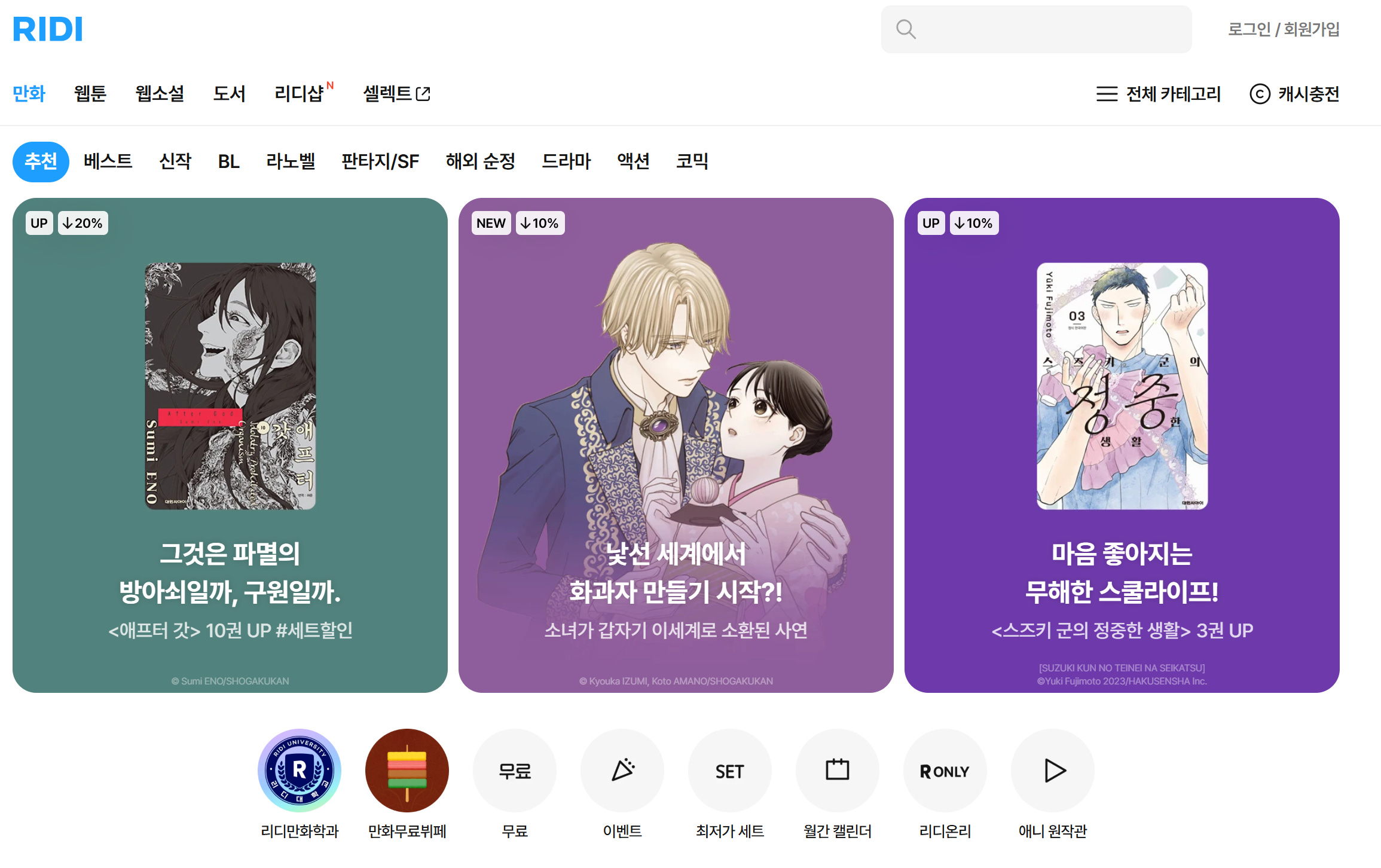
In Korea, we refer to these as “promotions” (yes, I know it’s the same word in English, but it still bears mentioning). This can be something as simple as a banner on the main page to a discount or free episodes.
And therein lies the rub.
According to reports, Ridibooks has variable platform fees as a part of their licensing agreements for webnovels.
That means that the platform commission can increase beyond a base rate. And, according to reports, that increase occurs when titles undergo special promotions on the Ridibooks platform.
Remember, promotions are highly sought after by publishers and authors in the digital content market. Platforms determine which titles are elligible for promotions. And, if the reports are true, platforms take a larger share of the revenue when titles are promoted on digital content platforms.
While that may be concerning on its own, the problem is immediately evident if the promotion includes a discount. Under normal circumstances, a 20% discount would result in a 20% reduction of the revenue earned by the publisher/author and the platform. But if the platform’s rate is increased, then it’s possible that the platform’s net revenue is unchanged and the discount is offset to the publisher/author.

The controversy regarding content promotions isn’t new. Authors and creators in the webnovel and webtoon industries have seen that promotions can lead to skyrocketing revenues, but due to the limited nature of promotions, there are never enough slots to go around.
But the added wrinkle of variable rates regarding platform commissions is new(ish). Which is why we have Twitter threads reporting on the practice.
Mr. Smith (RIDI) Goes to Washington (Parliament)
Creatives raising issues on social media isn’t new. For any locale.
But specifically for Korea, Twitter (I refuse to call it X) is where a lot of these issues are brought to light and gain prominence. And if a scandal lives and dies on social media, most companies can breathe a sigh of relief.
Yesterday, October 7th, Bae Ki-sik, the CEO of Ridibooks, was called to testify before a parliamentary hearing of the National Assembly’s Culture, Sports, and Tourism Committee.
The Culture, Sports, and Tourism Committee in Korea is essentially the equivalent to a congressional committee for Americans out there.
The session wasn’t overly long, but the questions were direct.
Does Ridibooks use variable platform fees?
Is this fair to creatives?
Will Ridibooks be changing their policies?
Overall, the CEO of Ridibooks didn’t give any direct answers other than to say that Ridibooks’ policies are in line with industry norms. And at the end of the questioning, the politician asking the questions basically railroaded Bae into promising to do better.
That begs yet another question.
How many other digital content platforms are employing variable platform fees?
The Korean government has actually forced changes on the webtoon and webnovel industries in the past. Parliament will issue opinions and notices requesting companies to make change to contract terms and forcing changes in more extreme cases.
One of the largest cases dealt with “Black Rubber Shoes” which has resulted in the Korean government attempting to remove the right to create derivative works from boilerplate contracts for the publication of webtoons and webnovels.
This is still making it’s way through the industry because it erodes one of the cornerstones of the business, but it’s a step in protecting the rights of creators and financial viability of original works.